During my UX/UI Bootcamp at Ironhack, I worked with the National Institute of Wellbeing as a client. They tasked me with creating an application aimed at people with sleep issues.
Additionally, the organization required that the app allow users to upload their data and share it with a healthcare professional, making it essential to consider this feature from the very beginning of the ideation process.
Research
At this stage, it was found that “approximately 10% of adults in developed societies suffer from chronic insomnia. The problem increases with age.” Additionally, some studies have identified a relationship between vegetable consumption and sleep quality.
This information was crucial, as it showed that sleep disorders are a real issue for many people, indicating a potential market for our future application.
Surveys
Out of 22 surveys conducted, it was discovered that many respondents suffered from sleep disorders. Additionally, 61.9% admitted they did not use insomnia-related apps, as they considered them too expensive.
Interviews
In this stage, a total of five people were interviewed. One of the questions asked was: “What feature would you like to see in the app?” In response, Alma, 33 years old, said:
"I would like to receive tips and recommendations on how to sleep well"
Insights
At the end of the research, it was found that one of the main reasons people didn’t use sleep apps was due to their cost and complexity.
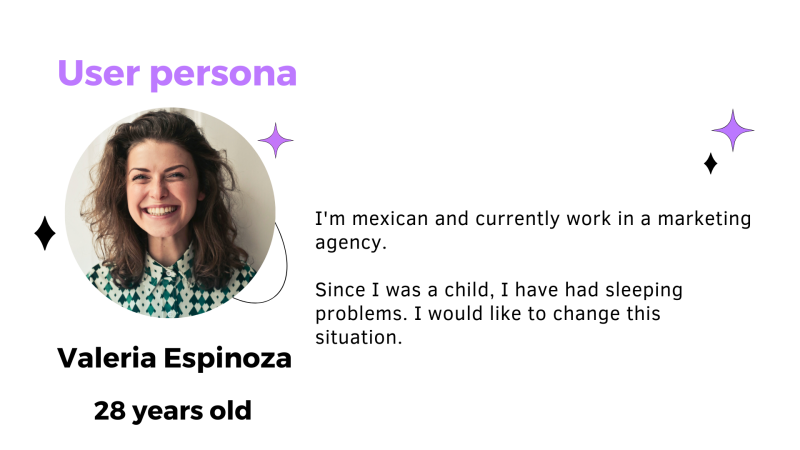
Thanks to the data above, we were able to identify the primary user of our application.
I discovered that many people had insomnia, which ultimately affected their productivity and health.
Crear una aplicación fácil de usar, que mostrara información clara en terminos de diseño y Ux writing.
The UX writing challenge here is to make improving sleep habits feel as achievable and motivating as starting a new personal challenge, while still conveying the seriousness and medical backing required for a health app.
🗣️ Brand Voice
The app’s voice is:
-
Clear and empathetic: communicates medical information accurately without using technical jargon that might alienate the user.
-
Motivating: inspires users to track and improve their sleep, celebrating small achievements.
-
Approachable and human: builds trust with a supportive tone rather than a scolding one.
🎚️ Tone by Context
-
Onboarding: warm and motivating, giving users the sense of starting a journey toward a healthier lifestyle.
-
Action confirmations: short, positive, and habit-reinforcing:
“Entry saved! Every step adds to better sleep.”
-
Warnings or errors: clear, direct, and reassuring, avoiding anxiety:
“We couldn’t record your night. Please try again shortly—your data is safe.”
-
Education or tips within the app: instructional tone with simple analogies connected to everyday life:
“Think of your sleep like a campaign: daily consistency is key to seeing results.”
-
Reminders or notifications: brief, friendly, and motivational:
“🌙 Time to disconnect. Give your body the rest it deserves.”
I discovered that users wanted an app that offered free features, such as relaxing sounds and sleep tips.
-
Objectives: Graphics that describe the sleep cycle in a simple and concise way for the user.
-
Personalized Information: Update your information on the main page to receive care tailored to your needs.
-
Relaxing Sounds: A catalog of soothing sounds available on the home page to help you fall asleep.
A closer relationship between the patient and their doctor
By completing your personal information, the app will give you the option to send your data to a specialized doctor. The app will also provide information about your potential doctor, allowing you to view their license and area of expertise.
After interacting with the design, users highlighted its clarity and sophistication. They also mentioned that the app inspired trust, as it provided information about the doctor who would be attending to them.




Crea tu propia página web con Webador